

Artificial Intelligence- a fundamental understanding for beginners

Updated: Dec 13, 2019
Audience:Beginners interested in understanding AI basics
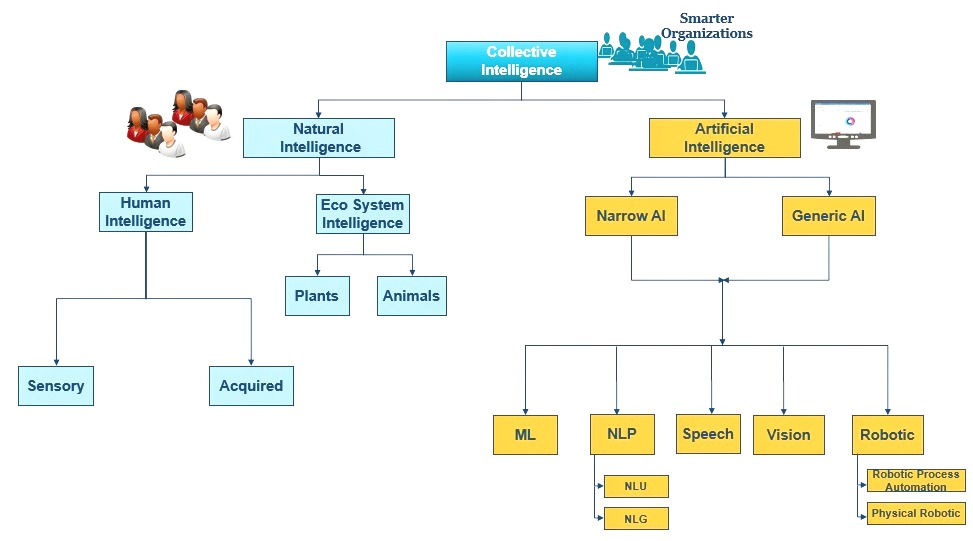
If there is something artificial, it must be having something natural as an inspiration. So let’s start our understanding of AI with a quick understanding of what natural intelligence means to individuals like you and me. While it is difficult to define "intelligence" in a few words , for the purposes of this discussion let's understand "Intelligence" as the ability of an entity to assimilate, process, interpret & respond to things happening around us.The response by an intelligent entity could be to solve a problem like an innovation to address lack of diagnostic services in developing nations or to appreciate a situation in our day to day life like sensory intelligence to assess an object coming too close to us and quickly swerving out of the way. I broadly classify intelligence into natural, artificial and collective intelligence depending on the players involved. Let's look at the combined picture and individual concepts in a bit more detail. Following chart elucidates the individual concepts and their relationships as a high level summary.
Let's dive a little deeper into the individual concepts as follows:
Natural intelligence is the intelligence that exists naturally in humans and the natural ecosystem. Humans have all the naturally bestowed sensory intelligence (visual, somatic, acoustic, olfactory etc) plus the cultivated or acquired ones (Higher Intelligence Quotient or IQ due to learning, stronger Emotional Intelligence or EI due to life experiences etc). Ecosystem intelligence is best elucidated by life around us in things like trees shedding leaves in certain seasons and coming back in full bloom in another or in the ability of sniffer dogs to sense, process and alarm its handler of any risks - we all know the scientific reasons today. Many a times the intelligence of the natural ecosystem becomes a direct inspiration to design machines that can behave intelligently to address certain needs but they are not the only inspiration by any means. Creative thinking , necessity of the solution could also lead to development of more efficient and sharper machines. In memory computing machines are a case in point. These machines are able to process and make sense of huge amount of data in a fraction of seconds, an art unfathomable for a human mind. Following is a high level pictorial representation of natural intelligence and its building blocks.

Artificial intelligence is broadly defined as the intelligence exhibited by machines. I would not just limit it as the emulation of natural intelligence by machines. I think the potential and horizons are very wide here. I would broadly define it as any kind of intelligence that is not natural. This is anything that a machine does or will be able to do to emulate and potentially surpass natural intelligence. AI can further be classified into narrow AI and generic AI with an evolving set of building blocks such as Machine learning or ML, Natural Language Processing or NLP, Speech technology , Computer vision and robotic- including physcial and Robotic Process Automation-RPA under them.
Narrow AI is defined as “a machine-based system designed to address a specific problem (such as playing Go or chess)” (Kiron 2017). In contrast, generic AI refers to machines with the ability to solve many different types of problems on their own, like humans can. To date, all applications of AI are examples of narrow AI. Although generic AI is currently a hot research topic, it is still likely decades away from true realization.

Let's dive a little deeper into each building block of AI as follows:
Machine learning (ML): Traditionally, most machines would be programmed to work using a logical sequence of steps most probably using an "If-Then" logic or a sequence of steps to execute a certain process. Machine learning is based on the fundamental of training the machine by exposing it to experiences for it to learn and apply the learning to solve a problem. Take for example the problem statement of the need to diagnose a tumor being malignant or benign. Machine learning driven solutions build up the required knowledge by training themselves on huge amount of practical experiences that medical professionals are exposed to for such a diagnosis. This may include exposure of the machine to symptoms observed, diagnostic tests , expert opinion, final results etc for a number of patients for both kind of cases. Based on the experiences that the machine is able to go through, it develops the capability to make predictions and the diagnosis. Quality of the machine's diagnosis is a function of the quality and variations of the target scenarios it is exposed to . A machine trained on good data churns out better results as compared to another trained on not so good data (sounds like what happens in real life as well with human beings). In simple terms, Machine Learning (ML) is the ability of a machine to learn from experiences it is exposed to and to apply the learning to solve a problem without the need of any explicit programming. Machine Learning is used extensively in the industry to solve clustering problems as required for customer segmentation & target marketing, prediction problems like population growth, market ,weather & advertising effectiveness forecasting, classification problems like medical diagnostics, fraud identification, image classification , customer retention and dimensions reduction problems like big data visualization of player's statistics during a FIFA match and much more.
Natural Language Processing (NLP): is the building block in AI that looks at the task of ingesting natural language in the form of text or speech, it's semantic and syntactical analysis to make deep contextual interpretation in order to interact with other target entities or to take any actions based on the interpretation. Some common day examples of NLP are email spam filtering and chat boxes. Email spam filtering works by looking at text in emails, analyzing its source & text to interpret if the email is truly relevant for the recipient and then take the action to segregate it into spam or relevant bucket. Chat boxes are another good example.Text- or voice-based chat bots can do mundane, routine part of the work previously performed by human customer service representatives as an assistant. The chat bots take care of routine matters like furnishing a bank statement, answering questions on account balance, payment schedules etc while more complex requests are transferred to human representatives, leading to a higher quality of service. In the industry NLP is being extensively used for sentiment and adverse event analysis as in case of pharma and media companies in particular to segregate valuable signal from the noise of overflowing online content to segregate news about their drug/campaign launch or in banking and financial sector to assess signals that indicate bankruptcy of accounts in their portfolio through information available in online content beyond the financial information they are currently exposed to. There are companies that use natural language generation (NLG) as an action to produce documents, such as articles about sporting events & board room summaries. Routine legal processes during legal discovery work like identifying responsive documents that must be turned over to the opposing party or to generate a complete standard contract based on inputs provided can be automated using NLP.
Speech Technology (ST): as an AI discipline deserves a separate mention given its growing adoption. Simply stated, it is the technology that allows a machine to identify spoken words or audio , analyze and interpret it in order to take an action or to communicate with a target entity. Three components of AI that are utilized in Speech technology are:
1. Automatic speech recognition- to understand the words the customer/originator is saying
2. NLP for interpretation – what customer/originator wants to know
3. Response construction & delivery- what and how to respond to customer's/originator's
questions

Google home, Alexa, Siri and automated customer service response to a customer inquiry are some day to day examples where speech technology is in use. In the industry, speech technology is being used for customer care, managing and monitoring of standard job functions like temperature and pressure calibration in manufacturing companies and as assistants to employees in scheduling, launching and recording meetings, placing calls etc.
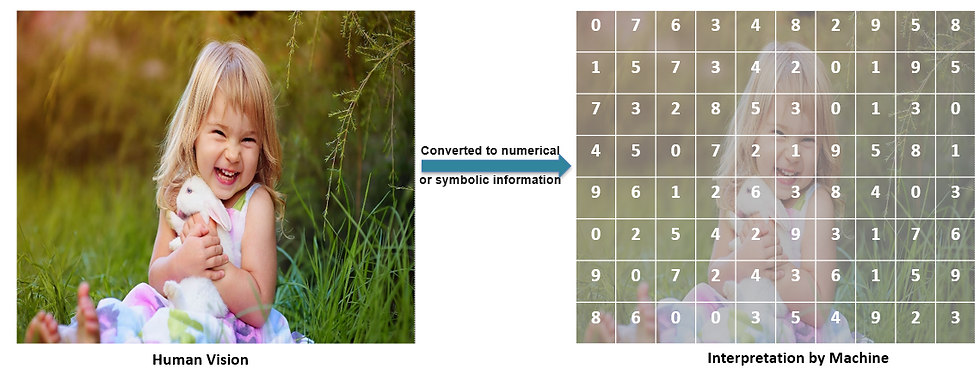
Computer Vision (CV): is the discipline of AI that makes machines understand images and videos. This discipline of AI is focused on developing machine capability to process and understand visuals like a human visual system would do.The image data can come from multiple sources and can be made available in various formats such as a video sequence, camera images or even images from medical scanners or Optical Character Recognition (OCRs). Machine interprets the images in the form of pixels, numbers and symbols with each image getting its own unique representation as elucidated in the following illustration.
There are numerous applications of computer vision. Some key applications are highlighted as follows:
Safety & Security: Computer vision is being used extensively in identifying safety risks in autonomous cars/smart homes/offices/industrial setups by perceiving the ambient visuals and taking adequate actions based on its interpretation. In case of autonomous cars, computer vision is helpful in assessing traffic around the vehicle and its risk propensity to be able to take timely action to avert an accident. Likewise, security cameras in remote locations of an industrial setup can tirelessly monitor the visuals and flag any anomaly to its supervisor for required action. Smarter homes/retail chains are leveraging computer vision driven surveillance to stay safe from theft or other untoward incidents.
Health: Computer vision is becoming extensively useful in the health sector to help identify anomalous health conditions based on analysis of ultrasound images, X-rays and scanned images from the patient. By interpreting the images computer vision is capable of detecting malignant tumors or abnormal dimensions of an organ to aid patient diagnosis.
Special Effects/VFX & Gaming : Computer Vision is being leveraged to do 3-D modeling , scene reconstruction and for various special effects in movie production and gaming to drastically reduce production timelines and costs. The ability of a gaming system to sense the players movement in a real world and its response to the player is a very common example of computer vision in play.
Secured access: The ability of a machine to recognize a person by face ID or thumb impression is another day to day practical application of computer/machine vision to help provide secured access to bank accounts, personal gadgets or payment systems to allow verified transactions only
Robotic: It is broadly defined as the science of developing a device/solution that can sense, compute, and actuate. If a tangible device, like an autonomous car or the Kiva warehouse robots used by Amazon, is leveraged to do a job, its called physical robotic. On the other hand if a software is leveraged to do a repetitive job, it is called Robotic Process Automation (RPA). Automation of the process to post manual journal entry in the accounting function of a company is an example of an RPA. In this case, there are no physical robots developed to deliver the outcome rather a software is developed to automate the manual process. Robotic has numerous applications that can be broadly classified as follows:
1. Physical Robotic that can be broadly classified into:
Factory robotic: Primarily developed for carrying our factory/manufacturing work that can be repetitive and with limited actions driven by specifications. Sawyer robot is a good example , it is developed to do the dull and dirty tasks of lifting and positioning material onto conveyor belts , sawing , drilling , assembly and many such repetitive tasks. Baxter is another example of factory robotic that learns to fix mistakes from a human helper, who communicates with the machine via electrodes to teach it what to do in a factory setting
Warehouse robotic: These robots are designed to carry out warehouse specific logistical work like identifying package location, carrying packages from one point to the other and assisting warehouse associates in package dispatch. Amazon's Kiva robot is a successful case in point. It helps reduce manual effort in the warehouse and makes the process more productive.
Service robotic: These robots are primarily focused on providing a certain service to a customer. The services could cover a wide variety and include hospitality, elderly care, food services etc. Japan with it's growing elderly population is among the early adopters of elderly care robots to help alleviate loneliness and elderly healthcare issues. While there are many robots offering elderly care services across the globe, Rudy standouts with a comprehensive offering of services at affordable rates. Henn-na hotel in Nagasaki, Japan is a robot staffed hotel that manages most of its tasks with the help of robots. Zume , a California based company, uses robots to make pizzas and then bake them in ovens installed in delivery vans.
2. Robotic Process Automation (RPA): is the discipline of robotic that deals with automation of a manual process using a software and not a physical robot. RPAs are primary used for ingesting templatized data, its preparation, processing and integration with other downstream IT systems. Manual Journal entry postings done by accounting team in a company , periodic creation of voluminous master data by some companies , customer and vendor order creation, invoice postings, payroll processing etc are some of the common examples from the industry where RPAs have been deployed to create noticeable automation benefits. Another day to day example of RPA is the process by which social media companies like Facebook and LinkedIn process updates coming from individual members from across the globe. The volumes are very high and to manage the traffic, these companies typically deploy RPAs that segregate the incoming data into logical batches so as not to overload the back end servers processing the update requests.
Collective intelligence: I will like to quote Professor Malone from MIT here to define Collective intelligence "as group of individuals acting collectively in ways that seem intelligent" . Machines and technology advancements have and will further broaden this definition to probably include "group of individuals, machines and the combined ecosystem".

This to me is the ultimate future and our enabler for our graduation from narrow AI to generic AI in the coming days . In the current phase, my view is that narrow AI with point solutions ( diagnostic AI , robotics, autonomous Cars, the AlphaGos of the world) will proliferate till a point its mature enough to collaborate with other point solutions to achieve what is called the generic AI. In Japan, there is need for taking care of the aging population and robotics is being explored as a health care and companionship solution (I'm recollecting this from a recent book that I read- "The Industries of the future" by Alec Ross). Generic AI in the context of Japan's need for health care and companionship solution for its aging population is about enabling the whole nine yards of AI solution that can integrate the narrow AI solutions like diagnostic AI for medical support, robotics for companionship and nursing, autonomous cars for safe driving and AlphaGo for entertainment of the aging population along with human healthcare professional networks in loop. So if we see the picture together collective Intelligence is the synergy of natural and artificial intelligence. Leading research work has proved that collective intelligence of diverse humans and machine leads to smarter organizations.


Comments